
OPC vs SRC vs PPC Cement: Which One Does Your Project Need?
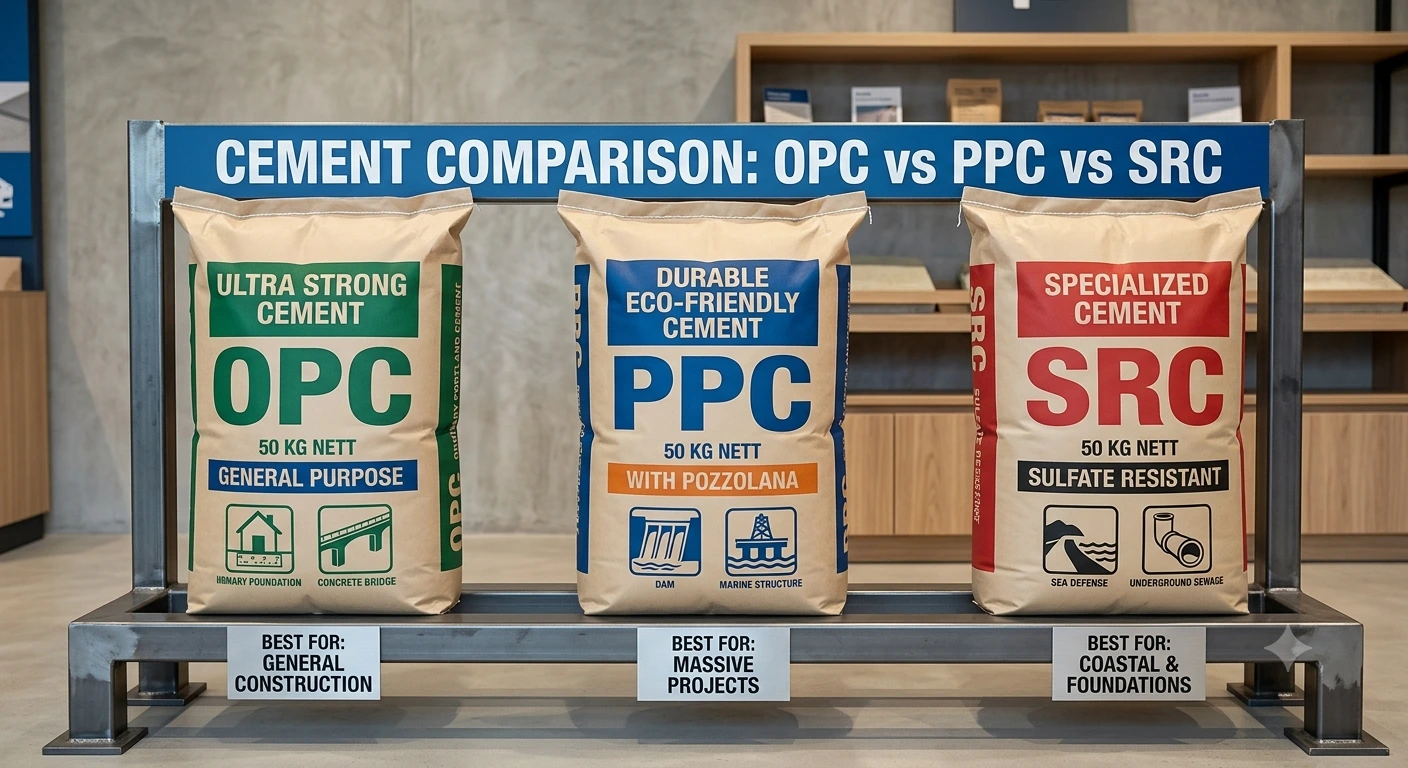
OPC vs SRC vs PPC Cement is one of the most common questions among homeowners, builders, and contractors. Although these cement types may look similar, each is designed for different construction conditions and applications. Ask ten people which cement to buy and most will name whatever brand is most advertised but the brand matters less than the type. Ordinary Portland Cement, Sulfate Resistant Cement, and Portland Pozzolana Cement are formulated for genuinely different conditions, and using the wrong one doesn’t just waste money it can shorten the life of the structure.
What Is OPC (Ordinary Portland Cement)?
OPC is the default, general-purpose cement used in most residential and commercial construction. It gains strength quickly, which is why it’s the standard choice for slabs, columns, plaster work, and boundary walls where there’s no unusual soil or water exposure to plan around.
What Is SRC (Sulfate Resistant Cement)?
Sulfate Resistant Cement is chemically formulated to resist attack from sulfate salts found in certain soils and groundwater — common in coastal areas and some low-lying sites. Standard OPC exposed to these conditions can gradually weaken as sulfates react with compounds in the cement paste. SRC is the safer choice for foundations, water tanks, retaining walls, and any structure below grade in a high-sulfate area.
What Is PPC (Portland Pozzolana Cement)?
PPC is a blended cement, mixed with a pozzolanic material that reacts more slowly than pure Portland cement. That slower reaction generates less heat during curing, which matters a great deal on large, thick concrete pours — mass foundations, dams, bridge piers — where too much internal heat can cause cracking as the concrete cools unevenly. PPC also tends to produce a denser, less permeable concrete over time, which is why it’s common on infrastructure projects.
Quick Decision Guide
- Standard house or boundary wall, no unusual soil: OPC
- Foundation, water tank, or coastal structure: SRC
- Large infrastructure pour, bridge, or dam: PPC
| Type | Best For | Main Benefit | Typical Applications |
|---|---|---|---|
| OPC | General construction | Fast strength gain | Houses, columns, slabs |
| SRC | Sulfate-rich environments | Sulfate resistance | Foundations, water tanks, coastal projects |
| PPC | Large concrete pours | Lower heat of hydration | Bridges, dams, infrastructure |
Frequently Asked Questions
Q. Can OPC be used for foundations?
Yes, where sulfate exposure is not expected. In coastal areas or sites with high-sulfate soil or groundwater, SRC is the safer choice.
Q. Is SRC stronger than OPC?
Not necessarily. It is more resistant to sulfate attack, which is a durability property rather than a raw strength advantage the design grade still determines load-bearing strength. If you’re unsure which cement type your project requires, consult your structural engineer and purchase from a trusted cement supplier that stocks certified products.
Q. Can I mix cement types on one project?
Yes, this is common. For example, SRC below ground for the foundation and OPC above ground for the superstructure, based on what each part of the structure is exposed to.
Q. Does PPC take longer to cure?
It reacts more slowly, which is intentional it reduces heat build-up in large pours. Your engineer’s curing schedule will account for this.
Q. Which cement is best for house construction?
For most residential projects, OPC is commonly used unless the engineer specifies another type. If the site has sulfate-rich soil or groundwater, SRC may be recommended. Always follow the project specifications.
Need genuine cement or electrical cables?
Our team supplies genuine, certified cement and cable across Karachi and Sindh — tell us what you need and we’ll help you get it right the first time.