
Building Wire vs Power Cable vs Armoured Cable: A Buyer’s Guide
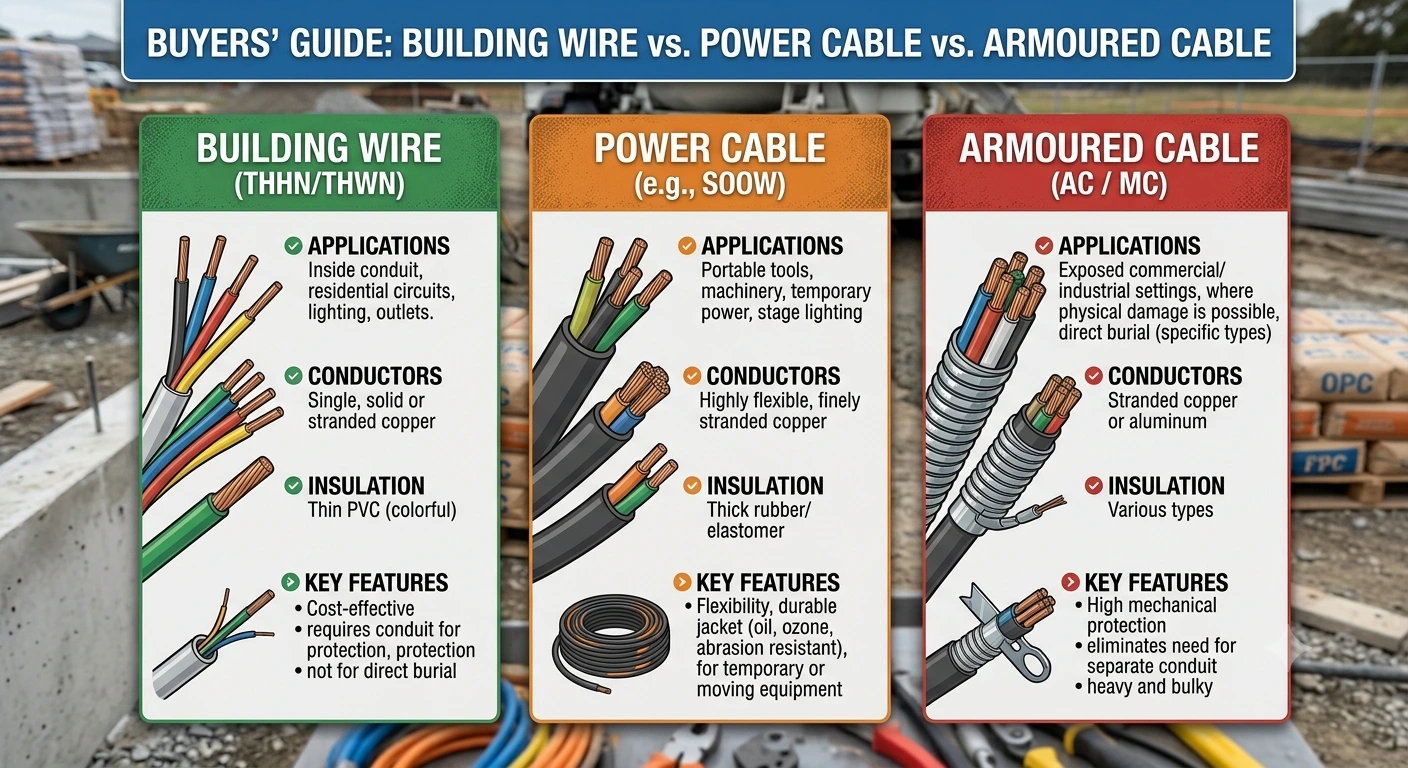
“Electrical cable” covers a wide range of genuinely different products, and mixing them up on a job — using building wire where armoured cable is needed, for instance — isn’t just inefficient, it can be a safety issue. Here’s what actually separates the main categories.
Building Wire
Building wire is flexible, PVC-insulated copper wire designed for standard indoor circuits — lighting, sockets, and general household or office wiring. It’s not designed for direct burial or heavy mechanical exposure; it belongs inside conduit or trunking, indoors or in protected runs.
Power Cable
Power cable uses heavier-gauge conductors built to carry higher current loads across commercial and industrial distribution — feeding panels, larger equipment, or distribution boards where building wire’s current capacity would be insufficient or unsafe.
Armoured Cable
Armoured cable adds a steel-wire layer beneath the outer sheath, giving it mechanical protection that building wire and standard power cable don’t have. That makes it the right choice for underground runs, outdoor installations, and anywhere the cable is exposed to physical stress, digging, or rodent damage.
Control Cable
Control cable is a shielded, multicore cable used for low-voltage signal and instrumentation wiring — connecting sensors, control panels, and automation equipment where interference and signal clarity matter more than raw current capacity.
Quick Decision Guide
- Standard indoor wiring: Building Wire
- Heavy loads, panels, distribution: Power Cable
- Underground or outdoor runs: Armoured Cable
- Signal, sensors, PLC panels: Control Cable
Cable types at a glance
| Type | Best For | Mechanical Protection | Typical Location |
|---|---|---|---|
| Building Wire | Lighting, sockets | Low — needs conduit | Indoor, protected runs |
| Power Cable | Panels, heavy loads | Moderate | Indoor / protected commercial runs |
| Armoured Cable | Underground, outdoor | High — steel-wire armour | Buried, outdoor, exposed runs |
| Control Cable | Signal, sensors, PLCs | Shielded for interference | Control panels, automation |
Frequently Asked Questions
Q. Can building wire be buried underground?
No. Standard building wire is not designed for direct burial or heavy mechanical exposure — armoured cable is the correct choice for underground runs.
Q. What makes armoured cable different from power cable?
Armoured cable adds a steel-wire layer beneath the outer sheath for mechanical protection, which standard power cable doesn’t have — that’s what makes it suitable for burial and outdoor exposure.
Q. Why does control cable matter for automation projects?
It’s shielded to reduce interference, which protects signal clarity for sensors and control panels — something raw current-carrying capacity doesn’t address.
Need genuine cement or electrical cables?
Our team supplies genuine, certified cement and cable across Karachi and Sindh — tell us what you need and we’ll help you get it right the first time.